
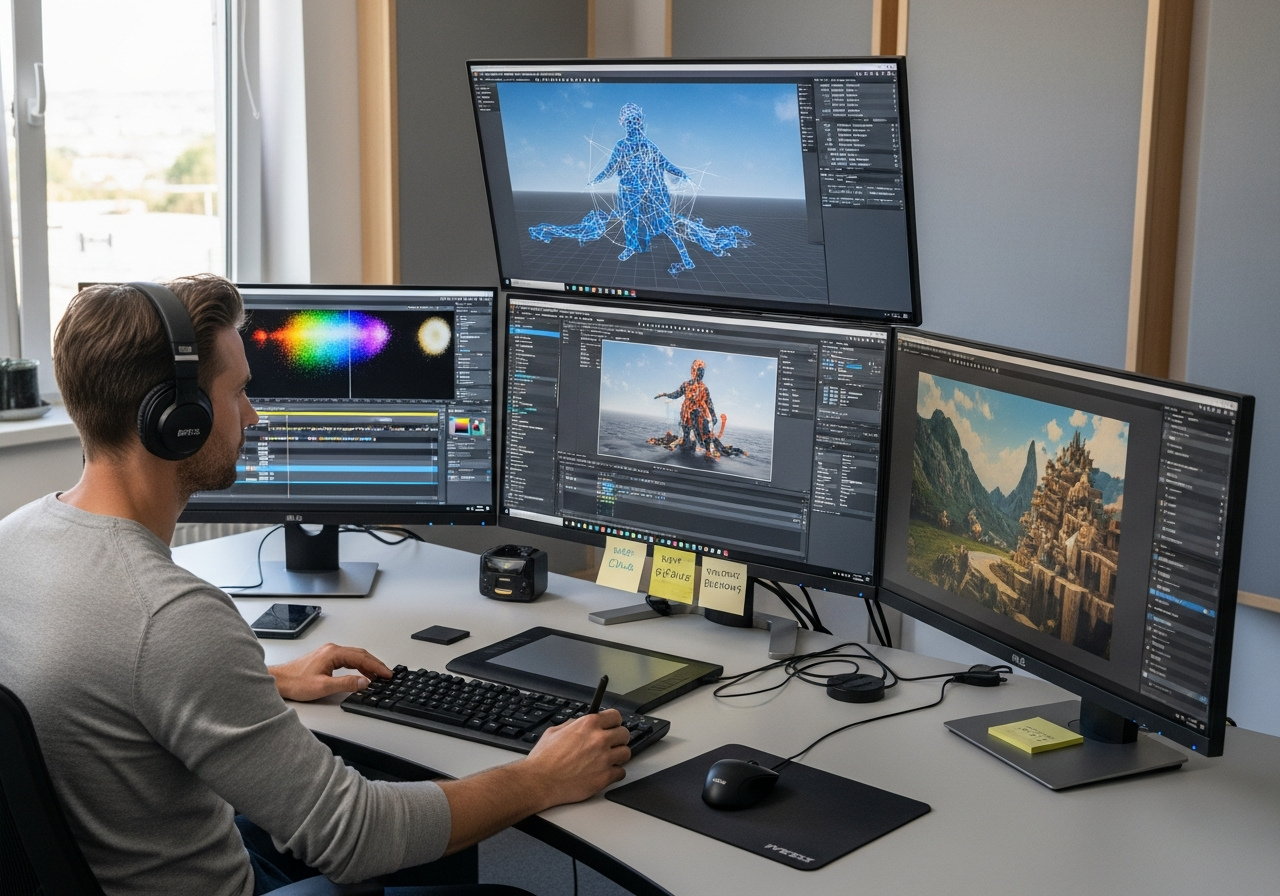
Canada’s visual effects industry continues to flourish, with Vancouver and Montreal serving as global hubs for major film and television productions. VFX students entering these markets face unique opportunities but require specific work authorization through co-op work permits. These permits serve as essential gateways to Post-Graduation Work Permits (PGWP) and eventual permanent residency pathways, making them crucial for international students pursuing careers in digital animation, compositing, and visual effects.
Recent Immigration, Refugees and Citizenship Canada (IRCC) policy changes affecting 2026 applications have introduced new considerations for VFX students at Designated Learning Institutions (DLIs). Understanding eligibility requirements, application processes, and industry-specific strategies becomes essential for securing these permits and accessing Canada’s competitive VFX job market.
What is a Co-op Work Permit and Why VFX Students Need It
A co-op work permit represents an open work authorization tied directly to DLI program requirements, allowing students to gain practical experience without securing a job offer first. For VFX students, these permits address industry-specific needs including hands-on studio experience with professional-grade software, networking opportunities with established professionals, and portfolio development using real-world projects that demonstrate technical proficiency to future employers.
The 2026 IRCC changes will make co-op work permits optional for certain post-secondary programs, but VFX programs typically maintain mandatory work experience components due to their technical nature. This requirement ensures students develop industry-relevant skills while contributing to Canada’s growing digital media sector through supervised placements at studios and production houses.
VFX programs differ significantly from traditional academic disciplines because they demand intensive practical training that cannot be replicated in classroom settings alone. Students must demonstrate proficiency with industry-standard tools like Maya, Houdini, and Nuke while understanding production pipelines used by major studios, making co-op placements essential for career preparation.
Key Features of Co-op Permits for Creative Programs
- Open work authorization allowing employment with any Canadian employer without job-specific restrictions
- No pre-arranged employment required before application submission to IRCC
- Duration matches study permit validity, typically covering multiple academic terms
- Direct pathway integration with PGWP eligibility for post-graduation employment
- Flexible scheduling accommodating both semester-based and intensive workshop formats common in VFX education
- Coverage for unpaid internships and paid positions equally under immigration regulations
VFX Program Differences from General Co-op
VFX co-op placements typically involve intensive, project-based work cycles that mirror actual production schedules in the entertainment industry. Students often work on live projects under tight deadlines, gaining exposure to specialized departments like lighting, texturing, and motion capture that require hands-on mentorship from experienced artists.
These placements emphasize portfolio-building benefits more than traditional co-ops, as VFX professionals advance their careers primarily through demonstrated reel quality rather than academic credentials alone. Students create professional-grade work samples during co-op terms that directly impact their employability upon graduation.
Eligibility Criteria for VFX Students
VFX students must meet specific requirements that differ from general co-op eligibility due to the technical nature of their programs and industry partnerships. These criteria ensure students can effectively contribute to studio environments while gaining valuable experience.
| Criterion | VFX Student Requirement | Evidence Needed |
|---|---|---|
| DLI Enrollment Status | Full-time enrollment in VFX/animation program | Official transcript and enrollment letter |
| Work Experience Requirement | Co-op mandatory for program completion | Co-op coordinator letter detailing requirements |
| Study Permit Validity | Valid study permit throughout co-op period | Current study permit copy |
| Academic Standing | Satisfactory progress in VFX coursework | Recent official transcripts |
| Program Duration | Minimum 8-month program length | Program outline from institution |
| Technical Prerequisites | Completion of foundational VFX courses | Course completion certificates |
| Industry Readiness | Basic portfolio demonstrating core skills | Portfolio review approval from department |
Top VFX DLIs and Their Co-op Requirements
Leading Canadian institutions offering VFX programs maintain strong industry partnerships that facilitate co-op placements, with each institution having specific requirements and application timelines. These DLIs have established relationships with major studios and boutique facilities across Canada.
- Vancouver Film School – Requires 3-month industry placement, partners with major studios like Industrial Light & Magic and MPC
- Sheridan College – Mandatory 14-week co-op term, strong connections to Toronto’s growing VFX sector
- Seneca Polytechnic – Two co-op terms available, focus on game development and traditional VFX pipelines
- BCIT Digital Design + Development – Intensive 4-month placement emphasizing technical artist roles
- Algonquin College – 12-week co-op with emphasis on animation and post-production workflows
- Emily Carr University – Project-based placements ranging from 3-6 months depending on studio needs
- Centre NAD – Quebec-based program with French and English language studio partnerships
Required Documents Checklist
VFX students must prepare specific documentation that addresses both general IRCC requirements and industry-specific elements unique to creative programs. Proper document preparation significantly impacts application processing times and approval rates.
- Valid passport with minimum 6 months remaining validity beyond intended co-op period
- Current study permit demonstrating legal status and program enrollment at recognized DLI
- VFX program-specific co-op letter from institution detailing work experience requirements and duration
- Completed IMM5710 form with accurate information matching all supporting documents
- Digital portfolio samples demonstrating technical competency for industry placement readiness
- Official transcripts showing satisfactory academic progress in VFX coursework and prerequisites
- Proof of financial support covering living expenses during unpaid or low-paid internship periods
- Medical examination results if required based on country of origin and program duration
How to Get Your VFX Co-op Letter
Obtaining the required co-op letter from your VFX program coordinator requires specific information and proper timing. Contact your institution’s co-op office at least 6-8 weeks before your intended application date, as processing internal documentation can take several weeks during busy periods.
When requesting your letter, provide clear details about your intended co-op timeline, preferred studio types, and any specific technical specializations you wish to pursue. The letter must explicitly state that work experience is mandatory for program completion, specify the duration and timing of the co-op term, and confirm your academic standing and eligibility.
Your co-op letter should include your full legal name matching passport documentation, student identification number, program details with start and end dates, specific co-op requirements including duration and timing, confirmation of satisfactory academic progress, and contact information for the issuing coordinator. Some institutions may require additional forms or meetings before issuing letters, particularly for international students.
Common Document Mistakes VFX Students Make
- Submitting incomplete IMM5710 forms with missing signature dates or unchecked mandatory fields
- Providing unclear document scans that cannot be properly reviewed by IRCC officers
- Mixing up application forms – using IMM1294 instead of IMM5710 for inside Canada applications
- Failing to update study permit information before applying for co-op authorization
- Submitting co-op letters that don’t explicitly state work experience is mandatory for graduation
Step-by-Step Application Process from Outside Canada
VFX students applying from outside Canada follow a specific process through IRCC’s online portal, with unique considerations for creative program documentation and timing around academic schedules.
| Step | Action | VFX Tip |
|---|---|---|
| 1 | Complete IRCC eligibility quiz | Select “work temporarily” and specify co-op program |
| 2 | Create GCKey account or sign in | Use consistent email matching school communications |
| 3 | Download and complete IMM1294 form | Specify “student co-op” in purpose field |
| 4 | Gather supporting documents | Include VFX program outline and studio partnership info |
| 5 | Pay application fee ($155 CAD) | No additional fees for co-op work permits |
| 6 | Submit complete application package | Apply 3-4 months before co-op start date |
| 7 | Provide biometrics if required | Book appointments early during busy seasons |
| 8 | Await decision and receive permit | Processing times vary by country and season |
Filling IMM1294 for VFX Co-op
The IMM1294 form requires specific attention to fields that may not be immediately obvious for VFX students. In the “Details of intended work in Canada” section, clearly specify that this is for co-op work experience related to your VFX program, not regular employment. Leave the employer name and address fields blank, as co-op permits are open work permits that don’t require pre-arranged employment.
When completing the purpose of visit section, select the appropriate category for work permits and specify “co-operative education work permit” in the details. Ensure all dates align with your study permit and co-op program timeline, as inconsistencies can lead to processing delays or refusals.
Pay particular attention to the education history section, where you should detail any previous VFX or related technical education that supports your current program enrollment. IRCC officers review this information to assess whether the co-op placement aligns with your educational background and career goals in the Canadian VFX industry.
Applying from Inside Canada (Most Common for VFX Students)
Most VFX students apply for co-op work permits while already studying in Canada, which requires using the IMM5710 form through IRCC’s online portal. This process typically offers faster processing times and more straightforward document submission procedures.
| Step | IRCC Portal Action | Timeline/Notes |
|---|---|---|
| 1 | Access GCKey account and select “Apply for work permit” | Begin process 8-10 weeks before co-op start |
| 2 | Complete eligibility questionnaire selecting “co-op student” | System generates IMM5710 form automatically |
| 3 | Fill IMM5710 with VFX program details | Allow 2-3 hours for careful completion |
| 4 | Upload required documents in specified formats | PDF files under 4MB each, high resolution scans |
| 5 | Pay fees online ($155 CAD work permit) | Co-op permits have no additional processing fees |
| 6 | Submit application and receive confirmation | Print confirmation for your records |
| 7 | Monitor application status through portal | Updates typically occur weekly |
| 8 | Receive decision letter through portal | Processing: 4-12 weeks depending on 2026 volumes |
| 9 | Print work permit document for employers | Required for SIN application and employment |
IMM5710 Form Guide for Co-op
- Personal Details Section: Enter information exactly matching your passport and study permit, ensuring consistency across all documents
- Contact Information: Provide current Canadian address and phone number where IRCC can reach you during processing
- Current Immigration Status: Select “student” and provide your current study permit number and expiry date
- Details of Intended Work: Choose “co-operative education work permit” and leave employer fields blank for open permits
- Work Permit Duration: Request period matching your co-op requirements, not exceeding study permit validity
- Education History: Include current VFX program details and any relevant previous education in creative or technical fields
- Signature and Date: Complete electronically if filing online, ensuring the date reflects when you finalize the form
Processing Times and Status Check
IRCC processing times for co-op work permits typically range from 4-12 weeks for inside Canada applications, with variations based on seasonal application volumes. VFX students often experience longer processing during busy periods coinciding with fall semester starts when many programs schedule co-op terms, so early application submission becomes crucial for meeting academic deadlines.
VFX-Specific Strategies for Approval
Success in obtaining co-op work permits for VFX students requires understanding the industry’s unique characteristics and demonstrating clear connections between academic programs and Canadian studio needs. IRCC officers evaluate applications based on the genuineness of the educational program and the student’s likelihood of contributing positively to Canada’s creative economy.
Building strong relationships with studio networks before applying can significantly enhance your application’s credibility. Many VFX programs maintain formal partnerships with local studios, and demonstrating awareness of these connections in your application materials shows serious commitment to the Canadian industry. Students should research studio pipelines, recent projects, and technical requirements to demonstrate industry knowledge.
Multiple co-op terms have become increasingly common in VFX programs due to the industry’s project-based nature. Students may complete several shorter placements at different studios rather than one extended term, allowing exposure to various specializations like character animation, environmental design, or technical direction. This approach requires careful coordination with permit validity periods and renewal timelines.
Best VFX Studios for Co-op Placements
| Studio | Location | Typical Co-op Roles | DLI Partners |
|---|---|---|---|
| MPC Vancouver | Vancouver, BC | Junior Compositor, Lighting Artist, Pipeline Support | Vancouver Film School, BCIT |
| DNEG Montreal | Montreal, QC | Environment Artist, FX Artist, Production Assistant | Centre NAD, Concordia University |
| Framestore Montreal | Montreal, QC | Character Animator, Texture Artist, R&D Support | Sheridan College, Centre NAD |
| Industrial Light & Magic | Vancouver, BC | Technical Artist, Creature Animator, Systems Support | Vancouver Film School, Emily Carr |
| Rodeo FX | Montreal, QC | Junior VFX Artist, Concept Artist, Production Coordinator | Centre NAD, UQAM |
| Method Studios | Vancouver, BC | Matte Painter, Tracking Artist, Editorial Assistant | BCIT, Vancouver Film School |
Fees, Validity, and Extensions
Co-op work permits for VFX students involve specific fee structures and validity periods that differ from regular work permits. Understanding these financial and temporal aspects helps students plan their academic and financial commitments effectively.
The standard work permit application fee applies to co-op permits, but students benefit from certain exemptions and considerations. Co-op work permit validity directly ties to study permit expiration dates, ensuring students cannot work beyond their authorized study period in Canada.
| Aspect | Details | VFX Note |
|---|---|---|
| Application Fee | $155 CAD standard work permit fee | No additional co-op processing fees |
| Permit Validity | Matches study permit expiration date | Cannot exceed program completion date |
| Extension Eligibility | Available if study permit remains valid | Common for multi-term VFX programs |
| Processing Time | 4-12 weeks inside Canada | Peak times during fall semester starts |
| Work Authorization Scope | Open permit – any Canadian employer | Includes freelance and contract work |
When to Apply for Extensions
- Submit extension applications at least 30 days before current permit expiry to maintain legal work status
- Apply for extensions when VFX programs require additional co-op terms beyond initial permit duration
- Consider extensions if study permit has been renewed and additional work experience becomes available
- File extension requests when transitioning between multiple co-op placements within the same academic program
- Apply for extensions early during busy processing periods to avoid gaps in work authorization
- Submit extension applications when studio projects extend beyond planned co-op completion dates
Post-Co-op: PGWP Transition
Co-op work experience positively impacts PGWP eligibility by demonstrating successful integration into Canada’s workforce and providing valuable Canadian work experience. Students who complete co-op terms often receive stronger reference letters and have established professional networks that facilitate post-graduation employment, both factors that IRCC considers favorably when assessing PGWP applications and subsequent permanent residence pathways.
Common Pitfalls and FAQs for VFX Co-op Applicants
VFX students frequently encounter specific challenges when applying for co-op work permits, often due to misunderstanding the open permit nature or program-specific requirements. Many students incorrectly assume they need secured job offers before applying, which can delay applications unnecessarily since co-op permits allow students to seek placement after approval.
The 50% rule misconception affects many applicants who believe co-op work cannot exceed 50% of their program duration. While this applies to regular part-time work during studies, formal co-op programs have different requirements based on curriculum needs. Understanding these distinctions prevents unnecessary application delays and ensures students apply for appropriate permit types.
Common rejection reasons include incomplete documentation, particularly missing co-op letters that don’t explicitly state work experience requirements, expired or inconsistent study permit information, and failure to demonstrate financial support during unpaid internship periods. Students should address these issues proactively to avoid application refusals that can impact future immigration applications.
- Believing job offers are required before applying – co-op permits are open permits allowing job searching after approval
- Applying too late relative to co-op start dates, not accounting for processing delays during busy periods
- Submitting co-op letters that don’t clearly state work experience is mandatory for program completion
- Mixing up application forms based on current location – IMM5710 for inside Canada, IMM1294 for outside Canada
- Assuming co-op work counts against study permit work limitations when it’s separately authorized
- Failing to maintain valid study permit status throughout the co-op work permit application process
- Not researching processing times specific to their visa office or current immigration status
- Submitting applications without confirming DLI status of their institution remains current and valid
Next Steps After Approval
- Apply for Social Insurance Number (SIN) using your approved work permit document at Service Canada
- Research tax obligations for co-op income and consider consulting with international student advisors
- Attend VFX industry networking events and studio open houses to maximize placement opportunities
- Update your portfolio with any new work created during academic terms before starting co-op applications
- Begin planning for Post-Graduation Work Permit application timing based on your program completion schedule